Deep Python tutorials plus Docker, Git, Kubernetes, AWS, and more — quizzes, challenges, and tools in one place.
class PythonDeveloper:
def __init__(self, name):
self.name = name
self.skills = []
self.certificates = []
def learn(self, topic):
self.skills.append(topic)
return f"✅ Learned {topic}!"
def get_certified(self):
self.certificates.append("🏆")
return "Certified!"
dev = PythonDeveloper("You")
print(dev.learn("FastAPI"))|
0+
Tutorial lessons (catalog)
0+
Practice quiz questions
0K+
Certificates earned
0K+
Learners in the community
Structured lesson paths — Python, delivery, data, and more
Tutorial tracks appear here when published. Staff can seed content or author lessons in the console.
Open tutorials hubData Structures & Algorithms — solved in Python
Python, cloud, DevOps, and more — test your knowledge
Solve real problems, earn points, climb the ranks
Compute the minimum total cost to connect all sticks into one stick by repeatedly combining two sticks with the smallest lengths.
Implement division of two integers using only bit shifts and arithmetic, without using division or modulo operators.
Return an array where output[i] is the product of all elements except nums[i], without using division.
Return all starting indices where any anagram of a given word appears as a substring.
Implement a function that finds keys shared by two dictionaries and returns them sorted.
Given a binary matrix, compute the largest rectangle area consisting entirely of 1s.
Write a function that returns the number of days between two given dates.
Remove all HTML tags from a string to extract clean text.
Implement the classic 0/1 Knapsack dynamic programming solution to maximize value under a weight capacity.
Implement a function that checks if a given integer is an Armstrong number.
Design a PlayingCard class with suit, rank, color, and equality/comparison magic methods.
Given a list of integers, return the index of any peak element where the value is not smaller than its neighbors.
Copy-ready snippets — study, paste, and run in the browser IDE
Python IDE
A full in-browser workspace: edit with syntax highlighting, run code with Pyodide, peek at stdout and stderr, and tidy with PEP 8 formatting — no install required.
# PythonSkillset IDE
def greet(name):
return f"Hello, {name}!"
print(greet("world"))
Illustration only — open the IDE for the real thing.
Code formatter
Paste messy code into a split editor, pick line length, and format with autopep8 on the server — then copy the result.
def calculate( x,y ):
result=x+y
if result>10:
print( "Big!" )
else:
print( "Small" )
return result
def calculate(x, y):
result = x + y
if result > 10:
print("Big!")
else:
print("Small")
return result
Illustration only — open the formatter to use your own code.
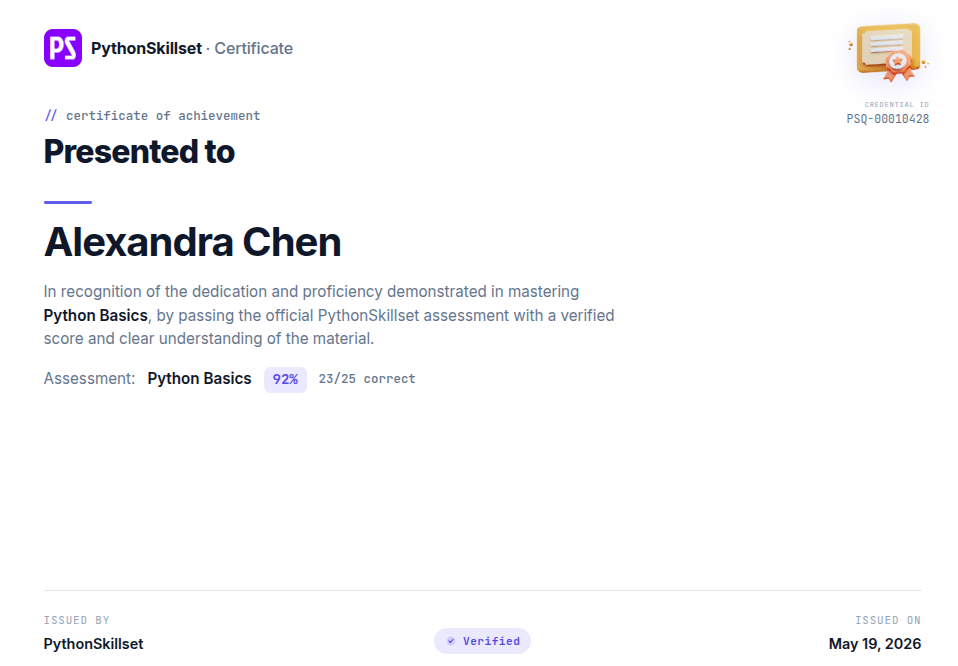
Pass any quiz at 80% or higher and receive a polished, shareable certificate — PDF download and print-ready HTML.
Sample certificate · click to open
This certificate is for course completion only and holds no academic or professional accreditation. See Terms of Use and Privacy Policy.
Top Python developers this month
Sarah Kim
Level 12
Raj Patel
Level 10
Lisa Chen
Level 9
Alex Johnson
87 challenges
Priya Sharma
72 challenges
Carlos Ruiz
65 challenges
Languages, tools, and notes worth keeping — sorted by topic with runnable examples when they help.
Explore why Python's standard json module lags behind orjson and ujson in speed and memory. Learn the core optimization principles and when to choose the right parser for …
An argument for a unified, modern CLI framework in Python's standard library, highlighting the costs of …
PythonExplore the real reasons Python runs slower than compiled languages—interpreter overhead, dynamic typing, and the GIL—and …
Cheat sheets, references, quizzes, and the full resource library